 by Axiom Technology Expert
Home / Public case studies / DiStefano v. KW Solar Solutions
Property · Public case studyDiStefano v. KW Solar Solutions
Illustrative model, not the property · C.A. N16C-11-015 CLS · DiStefano v. KW Solar Solutions, Inc.
A step-by-step illustration of a Delaware Superior Court opinion on the defendants’ motion to exclude the plaintiffs’ mold expert. The owners of a single-family home in Wilmington, Delaware sued the solar-panel installer on five causes of action. The opinion sets out what the expert may and may not testify about.
Interactive 3D · PDF annex (2.9 MB) · Video (1 min 48)
Key details from the source record
- Case
- DiStefano v. KW Solar Solutions, Inc., C.A. No. N16C-11-015 CLS, Superior Court of the State of Delaware
- Motion
- To exclude the plaintiffs’ expert · submitted March 15, 2019 · decided June 27, 2019 (p. 1)
- Claims
- Negligent Construction/Installation, Breach of Contract, Breach of Express Warranty, Breach of Implied Warranty, Violation of Consumer Fraud Act (p. 2)
- Source
- The 18-page opinion only; the inspection reports it cites were not available
- Credits
- Flat Solar Panel by michu, Poly Pizza, CC0 · Three.js r128, MIT License
Step-by-step reconstruction sequence
The court opinion step by step: the allegations, the mold testing, the ruling
- Step 01
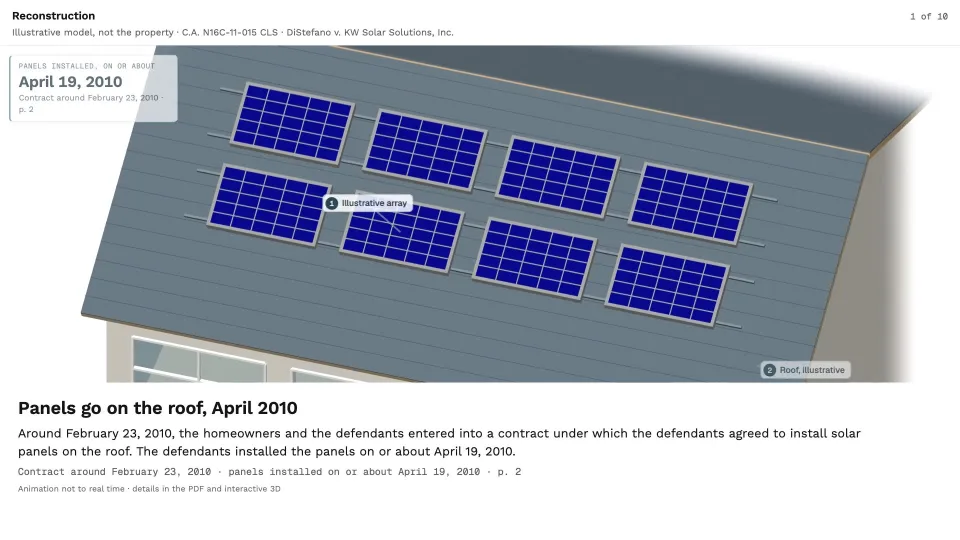
Panels go on the roof, April 2010
Around February 23, 2010, the homeowners and the defendants entered into a contract under which the defendants agreed to install solar panels on the roof. The defendants installed the panels on or about April 19, 2010.
Eight panels in two rows is an illustrative count and layout: the opinion gives no number of panels, no make, no roof face and no mounting details.
- Step 02
Early May 2016: water through the ceiling
By around early May 2016, water began to leak through the ceiling. By their account, the homeowners then found that a portion of their roof had rotted and saw substances around the leak that they suspected to be mold. That month they hired a mold inspector to assess and test the impacted areas.
The opinion does not locate the leak, the rot or the suspected mold: the ring marks an illustrative point on the top-floor ceiling. Nothing on this page traces a path for the water.
- Step 03
One mount, layer by layer
A generic roof section around one mount, taken apart: rafter, roof decking, membrane, shingles, a generic L bracket with its fastener, and a rail carrying a panel. The opinion describes none of these parts; the stack only shows where the allegations on the next pages sit.
A generic, illustrative stack: layer thicknesses are exaggerated and the exploded spacing is diagrammatic. It is not the equipment installed in 2010 and not an installation instruction.
- Step 04
Alleged: shingles and roof membrane cut
The plaintiffs allege “improper cutting of shingles in an attempt to secure the solar panels” and “improper cutting of the roof membrane while in the process of cutting shingles”. The notch and the slit only locate these two allegations in the model; they do not show that either happened.
Allegations only: the opinion makes no finding on them. Their shapes, positions and extent are unknown; the notch, the slit and the orange outline are illustrative.
- Step 05
Alleged: screws where galvanized nails were called for
The plaintiffs also allege “use of screws where installation called for galvanized nails”. Their other allegations: unsuitable mounting kits, no engineer consulted when deviating from standard installation practices, and an installation not assured to be water tight.
Silhouettes only, side by side for reading: neither is presented as the right one. The opinion does not say which fastener the installation required, which kit was used or how either was installed.
- Step 06
May 2016: second floor and attic sampled
In May 2016 the expert tested the second floor and the attic, including the attic roof sheathing the opinion describes as “directly affected by the leak”. He also took outdoor air samples, front and back, as a comparison baseline.
Each teal disc marks an area sampled, not a count, a result or a sample position; positions are illustrative. The outdoor comparison samples are not placed: their positions are not given.
- Step 07
June 2016: first floor and basement sampled
The expert testified that after the May inspection found mold in the attic HVAC system he suspected mold on the first floor and, based on his training, that the contamination may have spread to the basement HVAC system. His June 2016 inspection, he testified, confirmed mold there.
The two HVAC units are drawn apart with nothing between them: the model does not show how, or whether, mold spread. The amber discs mark areas sampled, not counts, results or sample positions.
- Step 08
Allowed: mold inspection and testing, for the areas sampled
The Court finds the expert qualified to testify on “the presence and levels of mold in the areas of the Property that he tested during each inspection”, and his methodology for mold testing “sufficiently reliable under Daubert”. His reports themselves limit their results to the areas sampled.
The rings mark the six areas sampled; the rest of the house is left neutral. No result, species or concentration is shown: the opinion gives none.
- Step 09
Limited: damage to the structure
The expert explained that mold “breaks down dead matter” and thus “can destroy the structural integrity of the home, the structure”. The Court finds him not qualified to testify on the remediation necessary to prevent structural damage, nor on the extent of damage to the structure.
Seen from below. The dark patches are symbolic, not the colour, extent, species or depth of anything found; the opinion makes no finding on structural damage.
- Step 10
Rejected: the installation as the cause
The expert admitted he was “hired to identify where there was mold”; despite this, his reports said the roof leak resulted from “wrongly” or “improperly” installed panels. The Court finds that causation opinion “is not based on sufficient facts or data and is not the product of reliable methods, it fails to meet Daubert.”
Nothing on this page connects the panels to the attic. The ruling finds neither that the installation caused the mold nor that it did not: it decides what this expert may say.
- Step 11
The ruling: motion denied, with limits
The Court denied the defendants’ motion to exclude the plaintiffs’ expert, after drawing three lines in its discussion. The ruling decides what this expert may testify about; it is not a finding on what caused the mold, nor on liability. The opinion does not say how the case ended.
Illustrative model, not the property; no scale is claimed. Credits: Flat Solar Panel by michu, Poly Pizza, CC0 · Three.js r128, MIT License.
Source & limitations: Shapes, positions and dimensions in the reconstruction are indicative; the report prevails.
Illustrative model, not the property: the house, its roof form, the eight-panel array, the mount hardware, the cut and damage shapes, the sample-marker positions and every dimension are invented for illustration. Nothing on these pages is drawn to a measured scale. People appear by role only.
3D reconstruction for property, fire and building claims
Need a confidential 3D reconstruction, QR-linked PDF annex, and video summary built from your own survey, engineering, or claim file?