 by Axiom Technology Expert
Home / Public case studies / Loss of the submersible Titan
Maritime · Public case studyLoss of the submersible Titan
Loss of the submersible Titan · 18 June 2023 · USCG, NTSB and TSB final reports
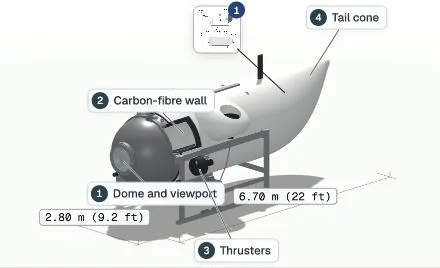
A step-by-step reconstruction of the loss of the submersible Titan during its dive to the wreck of the Titanic on 18 June 2023, as three official investigations established it: the U.S. Coast Guard’s Marine Board of Investigation (USCG), the U.S. National Transportation Safety Board (NTSB) and the Transportation Safety Board of Canada (TSB).
Interactive 3D · PDF annex (4.0 MB) · Video (1 min 27)
Key details from the source record
- Occurrence
- 18 June 2023, about 10:47 a.m. Newfoundland Daylight Time: the pressure hull fails and the vessel implodes during Dive 88, in the North Atlantic above the wreck of the Titanic
- Vehicle
- Submersible Titan, 6.70 m (22 ft) long, built and operated by OceanGate: a carbon-fibre cylinder between two titanium rings and two titanium domes
- Support
- A launch and recovery platform towed by the Canadian-flagged vessel Polar Prince
- On board
- Five persons. "All five persons on board the vessel died." (NTSB p. 1)
- USCG
- Report of the Marine Board of Investigation, MISLE Activity Number 7724663, August 4, 2025
- NTSB
- Report MIR-25-36, "Hull Failure and Implosion of Submersible Titan", October 2, 2025
- TSB
- Marine Transportation Safety Investigation Report M23A0169, released on 17 June 2026
- Purpose
- TSB: "It is not the function of the Board to assign fault or determine civil or criminal liability." NTSB: "The NTSB does not assign fault or blame for an accident or incident". The USCG report carries no such notice.
Step-by-step reconstruction sequence
The occurrence step by step, as the investigators saw it
- Step 01
370 nautical miles out
The Polar Prince left St. John’s, Newfoundland and Labrador, on 16 June 2023 with the Titan riding on its launch platform in tow, and reached the dive site above the wreck of the Titanic two days later. The USCG gives the bow of the Titanic at 41°43'55" N, 49°56'49" W.
Satellite image: NASA Blue Marble with seafloor relief, via NASA GIBS. St. John’s and Cape Race are placed at their geographic positions, which the reports do not give, and the route is drawn as a straight line: the ship’s own track is in the USCG’s figure. The image stretches east-west distances towards the north, so read distances from the text, not from the picture.
- Step 02
A carbon-fibre hull under a white shell
The Titan’s pressure hull was a carbon-fibre cylinder glued between two titanium rings, with a titanium dome bolted to each ring and an acrylic viewport in the forward dome. A white fibreglass shell covered the cylinder and ran aft into a tail cone; a metal frame on two landing skids carried the hull, and four electric thrusters moved it.
The TSB’s table gives a depth of 2.50 m and a weight of 9.525 tonnes; the USCG’s a vertical height of 8.3 feet and about 23,000 pounds (10,432 kg). The fairing’s shape, the frame’s sections and the thrusters’ exact places are estimated from the reports’ figures. The window in the hull exists only in this drawing.
- Step 03
The pressure hull, taken apart
What kept the sea out: the carbon-fibre cylinder, a titanium ring glued to each of its ends, a titanium dome bolted to each ring, and the acrylic viewport held in the forward dome by a retaining ring. The rings and domes came from a first hull, retired after a crack was found in its cylinder in 2019; the new cylinder was made between November 2020 and January 2021.
The viewport is described in different ways: 7 inches thick with an inner diameter of 12.5 inches in one passage of the USCG report, 5.5 inches thick for the replacement window it believes was fitted; 22 cm thick at its thickest point and 38.62 cm across inside in the TSB report, rated for 6.516 MPa, a depth of 649.08 m. The parts are moved apart along the axis for the drawing only.
- Step 04
Five layers, glued into a titanium ring
The wall of the cylinder was 5 inches of carbon fibre in five layers of about 1 inch, each wound and cured in turn and bonded to the one before with a film of adhesive. Each end of the wall sat in a C-shaped channel machined in a titanium ring, glued there with an epoxy paste applied by hand.
A section through the wall where it enters the forward ring, enlarged tenfold so that the adhesive can be seen. The alternating greys only tell the layers apart: the real wall is black. The ring’s outline follows an undimensioned drawing in the USCG report; the thickness of both adhesives is illustrative. The USCG report also writes that "The final structure consisted of 133 plies".
- Step 05
Dive 80: a bang, then a changed hull
On July 15, 2022, as the Titan came back up from the Titanic, those on board and a boat crew at the surface heard a loud bang, and the hull’s sensors recorded it. On the next dives the hull no longer strained as before. For the USCG and the NTSB the wall had likely delaminated; for the TSB, "it cannot be determined whether this event precipitated the non-linear readings".
The opening is a diagram, drawn 10 times real size: its width is not a measurement, and nobody examined the wall after Dive 80. The USCG report times the event at 3:26:45 p.m. on one page and at 3:26:56 p.m. on another. OceanGate concluded at the time that the bang "was caused by a shift in the TITAN’s position within its frame", and went on diving (USCG).
- Step 06
9:14 a.m.: the Titan leaves the platform
On 18 June 2023 a small boat took the five occupants from the Polar Prince to the Titan on its platform, and the forward dome was bolted shut behind them from outside. Divers flooded the platform’s tanks; platform and submersible sank together, the mechanisms holding the skids were released, and at 9:14 a.m. the Titan moved away and began Dive 88.
No report gives the distance between ship and platform at launch: the ship is drawn nearer than the 250 m of the tow in transit. The platform hangs under its buoys as the USCG describes, "buoys on each corner of the platform with approximately 30 feet of line attached"; where the buoys float, the Titan’s path off the platform and all timing are indicative. No diver, boat or person is drawn.
- Step 07
Down through 3,300 m of water
The Titan sank for an hour and a half, trading short text messages with the Polar Prince through an acoustic modem that also tracked it; there was no voice link. From 9:53:51 a.m. it gave no answer for 13 minutes. At 10:47:02 a.m., at 3,341 m, it sent its last message: "dropped two wts" (USCG).
Seen from the south-south-east. Sea, seabed and the Titanic’s bow are at true scale; the Titan is drawn 90 times and the ship 10 times larger. Seabed: GMRT depth grid (Ryan et al. 2009, CC BY 4.0), whose straight stripes are survey-track artefacts. No report gives the Titan’s path on the way down: it is drawn straight above the last tracked position, with the USCG’s depths at the USCG’s times and interpolation between them; the hour and a half is played in seconds. The Titanic’s bow is an intact-ship model standing in for the wreck (© 2026 KantLex, MIT License); its heading is indicative.
- Step 08
About 10:47: contact is lost
Seconds after its last message the Titan’s pressure hull failed and the vessel imploded, "approximately 500 m from the seabed" (TSB) and close to the Titanic’s bow. Tracking and messages stopped, and a bang was heard on the Polar Prince. The three reports give slightly different instants, depths and positions.
The fading cylinder, the arrows and the rings are a schematic of what the USCG calls "the loss of structural integrity of the TITAN pressure vessel" and of the sound that reached the ship; they do not show where the failure began. The Titan is drawn 10 times larger than the sea and the Titanic’s bow. The USCG prints the last position a second time as 41° 49.06' N, 048° 56.54' W (p. 261). It puts the bang heard on the ship at 10:47:11 a.m. and the delay of the messages at 15 to 30 seconds; the TSB puts the bang at 1047:34.522 and the delay at approximately 2.2 seconds.
- Step 09
On the seabed, near the Titanic’s bow
After a search by 11 vessels and four aircraft, a remotely operated vehicle found the wreckage on the seabed on 22 June 2023. The titanium domes were intact; the forward ring and the tail section lay each by itself. The carbon-fibre cylinder "had separated into numerous pieces of varying sizes" (TSB), delaminated between layers 1 and 2 and between layers 3 and 4 (NTSB). The viewport was not found.
No report gives a plan of the debris field or the position of any piece. Inside the disc the pieces are laid out schematically and drawn 16 times larger: only which pieces lay together, which lay alone and the 107 m are from the reports. The disc is centred on the one wreckage position visible in a report, the overlay of an ROV video frame (NTSB Figure 12). The NTSB’s two statements of distance and bearing from the bow are both plotted as written. Seabed: GMRT (Ryan et al. 2009, CC BY 4.0). Titanic hull: © 2026 KantLex, MIT License, an intact-ship model standing in for the wreck; its heading is indicative.
- Step 10
Three reports, three readings of the failure
All three investigations find that the carbon-fibre pressure hull failed, and that OceanGate had never established how strong it was or how long it would last. They differ on where the failure began and on what had weakened the hull.
The marks point at the places each report names; they are not measurements. On the viewport, the USCG writes that "it is unlikely that the acrylic window itself caused the implosion". The USCG report also concludes that the chief executive, as pilot, "exhibited negligence"; the NTSB and the TSB state that they do not assign fault.
- Step 11
What the three reports recommend
The recommendations go to authorities: the USCG’s to the Coast Guard itself, the NTSB’s to the US Coast Guard, the TSB’s to Canada’s Department of Transport. Several point the same way: binding standards for submersibles that carry people.
Gists, not the full wording: USCG pp. 324-327, NTSB p. 67, TSB pp. 124-129. The ship is a representative hull and the tow is drawn shorter than its 250 m.
- Step 12
Conclusion
For the USCG and the NTSB, a hull whose strength had never been established was likely damaged at the end of Dive 80 in July 2022, kept in service, and failed on its first dive to depth of the 2023 season. The TSB describes a cylinder that failed progressively, dive after dive. Neither the USCG nor the TSB could fix the exact point where the hull gave way.
Sources: the three reports named on the first page. Satellite image: NASA Blue Marble: Next Generation (NASA Earth Observatory), via NASA GIBS. Seafloor depths: Global Multi-Resolution Topography synthesis (GMRT), Ryan et al. 2009, doi:10.1029/2008GC002332, CC BY 4.0, not for navigation. Titanic hull: RMS Titanic model © 2026 KantLex, MIT License, github.com/KantLex/3D-Titanic-Model, cut and simplified. The other models were drawn for this reconstruction from the reports’ dimensions and figures.
Source & limitations: Shapes, positions and dimensions in the reconstruction are indicative; the report prevails.
Schematic reconstruction. The pressure hull is drawn to the reports’ dimensions; the fairing, frame, thrusters and equipment are estimated from the reports’ figures; the support vessel is representative; every position that no report gives, the wreckage as laid out and all timing are indicative. Where the three reports differ, each version is shown as written, attributed, and nothing is resolved here. No person is depicted. Page references are to the numbers printed on the reports’ pages.
Maritime 3D incident reconstruction
Need a confidential 3D reconstruction, QR-linked PDF annex, and video summary built from your own survey, engineering, or claim file?