 by Axiom Technology Expert
Home / Public case studies / New Dawn grounding
Maritime · Public case studyNew Dawn grounding
Grounding near Hood River, Columbia River · 9–10 July 2009 · EPA FPN E09005 · Tank barge New Dawn
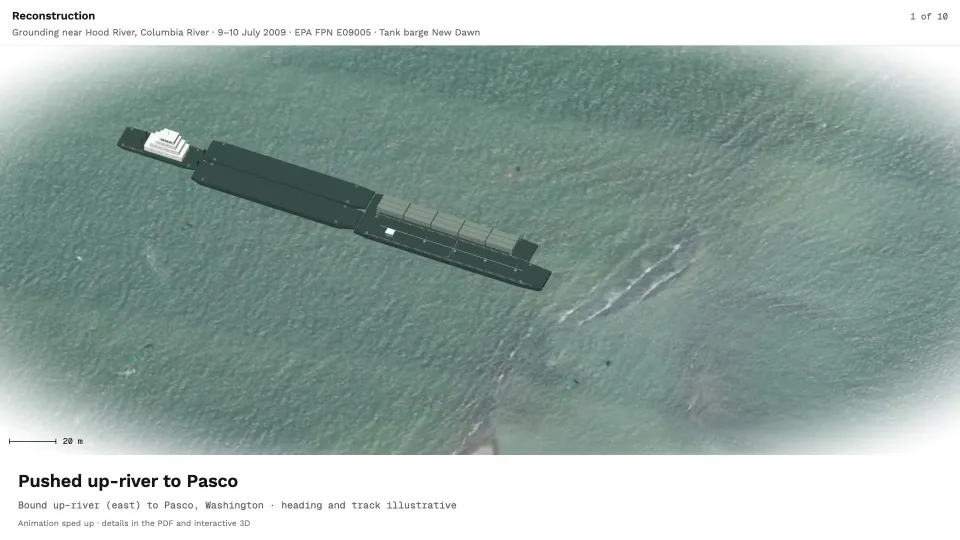
On 9 July 2009 at 0315 the tank barge New Dawn, pushed up-river by the tug The Chief, ran aground on a sand bar near the mouth of the Hood River, Columbia River, near river mile 169. On 10 July, after 12,318 barrels had been lightered to a second barge, it was backed off the bar. EPA reports no release to the Columbia River.
Interactive 3D · PDF annex (7.4 MB) · Video (1 min 30)
Key details from the source record
- Vessel
- New Dawn, double-hull tank barge; 284 × 42 × 16.5 ft on the operator’s current fleet sheet
- Cargo
- 25,000 barrels (bbl; 1,050,000 gallons) of gasoline, bound up-river for Pasco, Washington
- Aground
- 9 July 2009 at 0315 · sand bar near the mouth of the Hood River, near river mile 169 (Bonneville Pool)
- Off the bar
- 10 July 2009 at 1854, after 12,318 bbl (517,356 gallons) had been lightered
- Release
- None reported; neither hull reported breached
- Sources
- EPA, Washington Ecology, the operator’s specifications: last page
Step-by-step reconstruction sequence
The occurrence step by step, as the investigators saw it
- Step 01
Pushed up-river to Pasco
The river tug The Chief was pushing New Dawn up-river to Pasco, Washington, with 25,000 barrels (1,050,000 gallons) of gasoline aboard. According to Washington Ecology, the tug had in tow “a loaded petroleum barge, a loaded container barge carrying containerized solid waste and two additional empty barges.”
The tow’s formation and track and the other three barges’ sizes are not reported: drawn for illustration. The reviewed sources do not say where those three barges went after the grounding, so they appear only on the tow pages. The joint release rounds the cargo to “one million gallons” and Ecology to “1 million gallons”; EPA’s 1,050,000 gallons is used.
- Step 02
A double-hull barge
EPA describes New Dawn as “a double hull design”. The cutaway opens it: an outer hull, an inner hull, and the cargo tanks that the lightering plan names, port and starboard (P&S) tanks 1 and 3.
Explanatory cutaway, not damage: neither hull was reported breached. The tank layout is schematic and the gold blocks are normalized indicators of the cargo, not tank levels.
- Step 03
0315: aground on the bar
At 0315 New Dawn ran aground on a sand bar near the mouth of the Hood River, near river mile 169: “allegedly uncharted” in POLREP 1, “reportedly uncharted” in POLREP 2. River mile 169 lies in Bonneville Pool, between Bonneville Dam and The Dalles Dam.
The bar’s shape and depth, the water level, the drafts and where along the hull New Dawn touched are not reported: drawn for illustration (the bar is drawn under the printed position). Ecology’s summary dates the grounding July 8 and its July 9 update prints “3:15 p.m.”; this page follows EPA’s 0315.
- Step 04
≈1725: The Chief tries, the barge stays
A 1,500 foot security zone was set up around the grounded barge and tug. At ≈1725, after some water was released from The Dalles Dam to raise Bonneville Pool slightly, The Chief tried to free New Dawn “from a variety of angles with no success.”
Tug positions illustrative, water at one level. The zone is drawn on the first page, as a 1,500 ft radius (not stated). Ecology: attempts “with an additional tugboat”.
- Step 05
The lightering plan
The empty barge New Vision, pushed by the tug Defiance, came down-river to receive product. The plan: 60,000 gallons from each of New Dawn’s P&S tanks 1 to New Vision’s P&S tanks 2, 70,000 gallons from each of P&S tanks 3 to P&S tanks 4, up to double if needed. Manifolds: no hose reconnections between tanks.
A plan, not a tally. It also prepared for a potential 2,000-gallon hose-failure discharge; none is reported. New Vision’s place before 0900 is illustrative.
- Step 06
0900: New Vision turned 180°
At 0900 the persons-in-charge (PICs) decided to reposition New Vision “by turning it 180 degrees relative to the ‘New Dawn’”, so that the receiving barge would be in deeper water in case additional fuel had to be transferred off.
Only the 180-degree change is documented. New Vision’s heading and side before and after, the path of the turn and the place of the deeper water are illustrative.
- Step 07
1050–1800: lightering
Lightering began at 1050. By 1415 approximately 4,800 bbls had been lightered, lightening New Dawn by approximately 630 tons; by 1600 approximately 8,000 bbls, approximately 1,050 tons in total. Personnel on New Dawn then reported “some shuddering movements, but the barge was not yet floating free.” Lightering was halted after 12,318 bbls (517,356 gallons).
Gold blocks: normalized indicators (0.50728 / 0.49272 of 25,000 bbl at the end, calculated), not tank levels. Hose and lines illustrative. Ecology prints “500,00 gallons”; EPA’s 517,356 is used.
- Step 08
≈1800: it slides back
At approximately 1800 New Dawn “slid backwards slightly and the stern end pivoted.” Lightering was halted after transferring 12,318 bbls.
How far New Dawn slid and how far the stern swung are not reported: the movement drawn (2 m back, 2.5°) is illustrative. New Vision, still moored alongside, is drawn moving with it.
- Step 09
1845–1854: off the bar
At 1845 the mooring lines between the barges were released and New Vision was backed away. At 1854 New Dawn was backed off the bar and moved to a safe location for a USCG marine safety inspection.
The tracks and the safe location are not reported: illustrative. The hose is drawn disconnected before the barges part; when it was disconnected is not reported.
- Step 10
Inspected: no leaks
The USCG’s follow-up inspection of the interstitial spaces determined that the barge “had no leaks and retained its integrity.” “No release to the Columbia River water occurred.”
Explanatory cutaway: no breach, leak or release was reported. The space between the hulls is drawn schematically. After the grounding, the joint release says, the operator’s and Coast Guard personnel inspected the double hull and found no damage.
- Step 11
Afterwards, sources and discrepancies
Anticipated, not observed: New Dawn and The Chief to continue to Pasco, Washington, to offload the remaining cargo; New Vision and Defiance to the Portland area to offload the lightered cargo. Where the sources differ, EPA’s value is used and the other is shown beside it, as printed.
Illustrative reconstruction: no finding of fault or cause beyond the reports’ own words.
Source & limitations: Shapes, positions and dimensions in the reconstruction are indicative; the report prevails.
Illustrative reconstruction from public reports. Vessels at the operator’s current hull dimensions; positions, headings, drafts, tow formation, bar and water level drawn for illustration. Aerial image: NAIP 2017 and 2022, not the river of July 2009.
Maritime 3D incident reconstruction
Need a confidential 3D reconstruction, QR-linked PDF annex, and video summary built from your own survey, engineering, or claim file?