 by Axiom Technology Expert
Home / Public case studies / Concrete truck roll-away
Road traffic · Public case studyConcrete truck roll-away
Concrete truck roll-away · Post-Crash Analysis Report · 2021 · 2005 Peterbilt cement truck
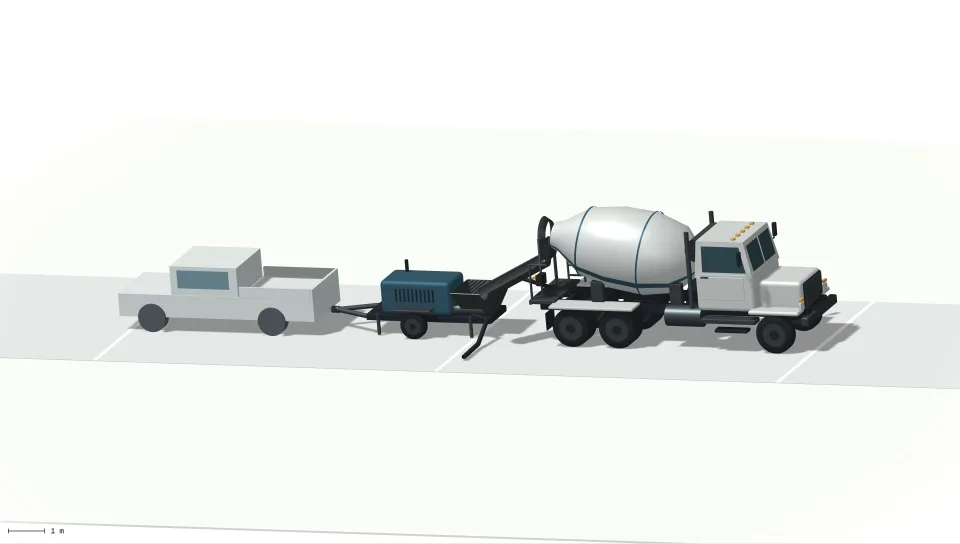
A step-by-step reconstruction of the roll-away of a concrete truck at a job site, as a post-crash investigation expert and air-brake instructor analysed it in his Post-Crash Analysis Report.
Interactive 3D · PDF annex (4.2 MB) · Video (1 min 17)
Key details from the source record
- Vehicle
- 2005 Peterbilt cement truck, three axles, air brakes
- Event
- Roll-away on a hill at a job site in a residential area, 2021: collision with a concrete pumper trailer
- Question put
- Did the driver apply the parking brakes upon parking the vehicle?
- Reviewed
- Vehicle examination report, police crash report, NEST and RING doorbell footage, brake photo, deposition
- Opinion
- The driver applied the parking brakes; these did not work and led to the runaway truck
Step-by-step reconstruction sequence
The occurrence step by step, as the investigators saw it
- Step 01
Parked uphill of the pumper
At the job site the driver reversed his concrete truck and stopped uphill, in front of a concrete pumper trailer operated by a second person. It was a clear, sunny day with little to no traffic.
The tow vehicle is a plain stand-in: the report mentions "the truck" of the pumper truck driver without describing it. The grade is drawn at 5°; the report says only that the truck was parked uphill and rolled down the hill.
- Step 02
Parking brakes on, then the pump starts
In the doorbell video the expert hears the service brakes being released and the parking brakes being applied. Eleven seconds later the engine of the pumper trailer starts: by then the driver was at the rear, the chute in the hopper, at controls that will not work if the parking brake is not applied.
The two times are positions in the NEST recording, as the expert reads its sound. The chute’s swing and the drum’s turning are drawn for illustration.
- Step 03
A rock under the wheel
According to the report, the driver knew the parking brakes on the cement truck were not working. He and the pumper truck driver placed a rock under the wheel to secure the vehicle in place.
The report does not say which wheel, or how large the rock was: both are indicative here.
- Step 04
The rock fails
After a short time, the rock failed. The cement truck rolled backward and slammed into the pumper trailer, crushing the plaintiff. It pushed the truck and trailer aside and continued to roll down the hill.
The report does not describe the point of contact, the side the trailer and its tow vehicle were pushed to, or any speed: the motion is indicative. No deformation and no person are drawn. The report later calls the collision fatal.
- Step 05
Almost six truck lengths
When the truck started to roll, the driver stood on the driver’s side running boards. The vehicle rolled almost six truck lengths before he wrestled himself into the cab.
The report gives the distance only as "almost six truck length". The stripes count lengths of the model truck; no distance in metres and no speed is derived.
- Step 06
Stopped with the brake pedal
The driver brought the vehicle to a stop with the front service brakes, the brake pedal. In the doorbell video the cab lifts up and back from the chassis as the truck stops; for the expert this shows that the front service brakes were working. Police reported no skid marks.
The report cites the RING recording at 08:12 and at 08:18 for the stop. NEST and RING are separate recordings: no duration is derived between them. The size of the cab’s lift is illustrative.
- Step 07
Four rear parking brakes
On an air-braked truck the parking and emergency brakes are only on the rear axles, to preserve steering. Post-crash investigators measured the pushrod travel at each brake. On three of the four rear parking brakes, the brake shoes did not come in contact with the drum.
Seen from below, rear wheels and mixing drum hidden. The report says the truck "is fitted with five brakes"; its Figure 1 has six measurement blocks. The model has six wheel ends, four of them with a rear parking-brake assembly.
- Step 08
Springs hold a parked truck
When the vehicle is parked, air is evacuated from the system and large, powerful springs expand and apply the brakes. Parking brakes remain on indefinitely owing to the mechanical force of the springs.
A generic, enlarged S-cam drum brake shown working as intended, its chamber casing removed to show the spring. It is an explanation of the principle, not a drawing of this truck’s brakes or evidence that any of them worked.
- Step 09
Paper fits between shoe and drum
With the parking brakes applied, the post-crash investigators were able to place pieces of paper between the brake shoes and the drum. For the expert, this indicated that the truck was devoid of parking and emergency brakes.
The report gives no size for the gap: it is enlarged here. Figure 1’s caption says the parking brakes were engaged on only one rear wheel, the left middle; the text lists the left-middle among the three brakes whose parking stroke fell short.
- Step 10
The parking stroke falls short
The expert compares, brake by brake, how far the pushrod travels with the service brakes applied and with the parking brakes applied. More than an inch is missing on two parking brakes and near an inch on another: for him, the spring-brake chambers required repair.
Which service brake was out of adjustment is not settled in the report: page 6 says the right-rear, the caption of Figure 1 the left rear. The expert computes 1 ½ inches for the right-rear where the police examination reported 2 ½ and suspects a typo. The wheel headings of Figure 1 are blacked out in this copy; the marks follow the list on page 8.
- Step 11
The expert’s opinion
In the expert’s opinion the driver applied the parking brakes of the 2005 Peterbilt cement truck. The parking brakes were inoperable: even though the driver applied them, they did not work and led to the runaway truck.
The opinion calls the parking brakes inoperable; the caption of Figure 1 describes them as engaged on one rear wheel. The page shows both as written.
Source & limitations: Shapes, positions and dimensions in the reconstruction are indicative; the report prevails.
Schematic reconstruction. The vehicles are representative models, not the actual truck, trailer or tow vehicle; sizes, the grade of the hill, positions, distances and timing are indicative: the report gives no survey. No person is depicted.
3D accident reconstruction for road claims and litigation
Need a confidential 3D reconstruction, QR-linked PDF annex, and video summary built from your own survey, engineering, or claim file?